Web 2.0 refers to the second generation of web development and design that focuses on user interactivity, collaboration, and content sharing.
- It transformed the internet from a static environment (Web 1.0) into a dynamic, user-driven platform.
Unlike Web 1.0, where content was created by a few and consumed by many, Web 2.0 empowers users to create, modify, and share content, making the web more social and participatory.
Web 1.0 vs Web 2.0:
| Feature | Web 1.0 | Web 2.0 |
|---|---|---|
| Content Flow | One-way (read-only) | Two-way (read/write) |
| Interactivity | Limited or none | High user interaction |
| Content Source | Created by website owners | Created by users (UGC – User Generated Content) |
| Examples | Static web pages, online brochures | Blogs, social media, forums |
Key Features of Web 2.0:
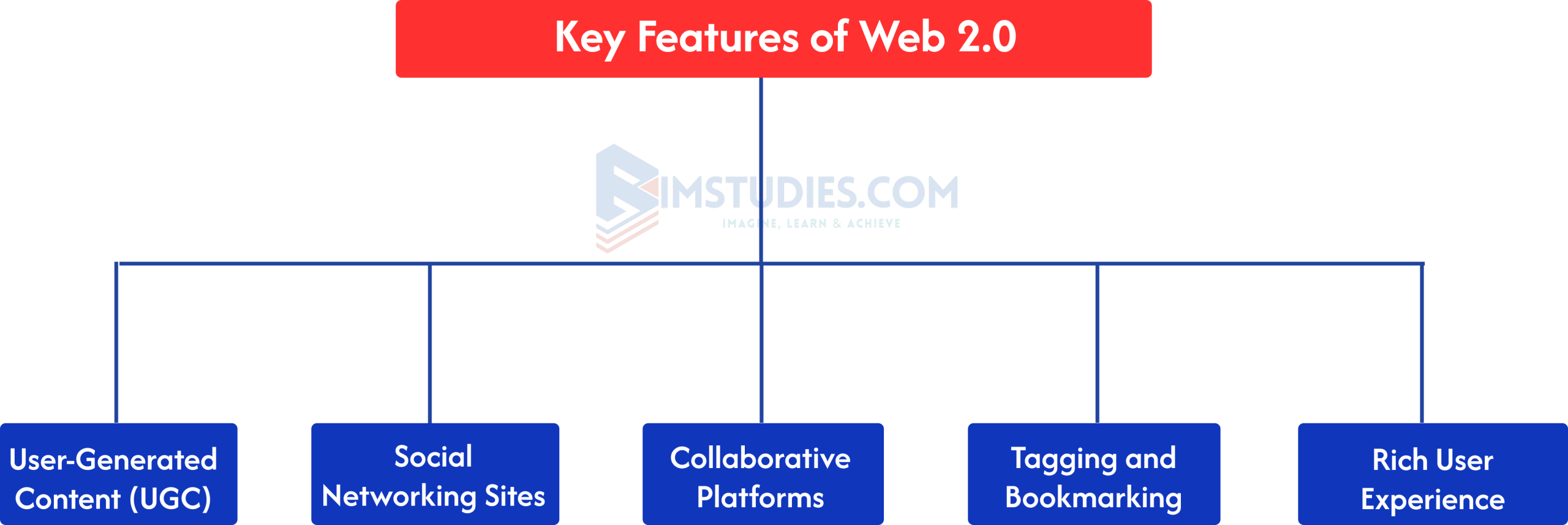
- User-Generated Content (UGC)
- Users actively contribute content in the form of blogs, reviews, posts, videos, and comments.
- Example: YouTube users upload videos; Reddit users post and vote on discussions.
- Social Networking Sites
- Platforms that allow users to connect, communicate, and share with others globally.
- Examples: Facebook, Twitter, Instagram, LinkedIn.
- Collaborative Platforms
- Web 2.0 enables collaboration across geographies with tools for co-editing and sharing.
- Examples: Wikipedia (crowdsourced encyclopedia), Google Docs (real-time document editing).
- Tagging and Bookmarking
- Users categorize content using tags or hashtags, making it easier to search and follow trends.
- Example: Pinterest allows users to “pin” content; Twitter uses hashtags like #TechNews.
- Rich User Experience
- Interactive designs using AJAX, JavaScript, and dynamic content provide seamless user interfaces.
- Example: Infinite scrolling on Facebook or live notifications on Instagram.
Connection to Social Computing:
Web 2.0 serves as the technological foundation of social computing. It supports the interaction, sharing, and collaboration necessary for platforms like:
- Facebook (social networking)
- Wikipedia (collaborative knowledge)
- TripAdvisor (user reviews)
- Quora (community-based Q&A)
Discussion 0